
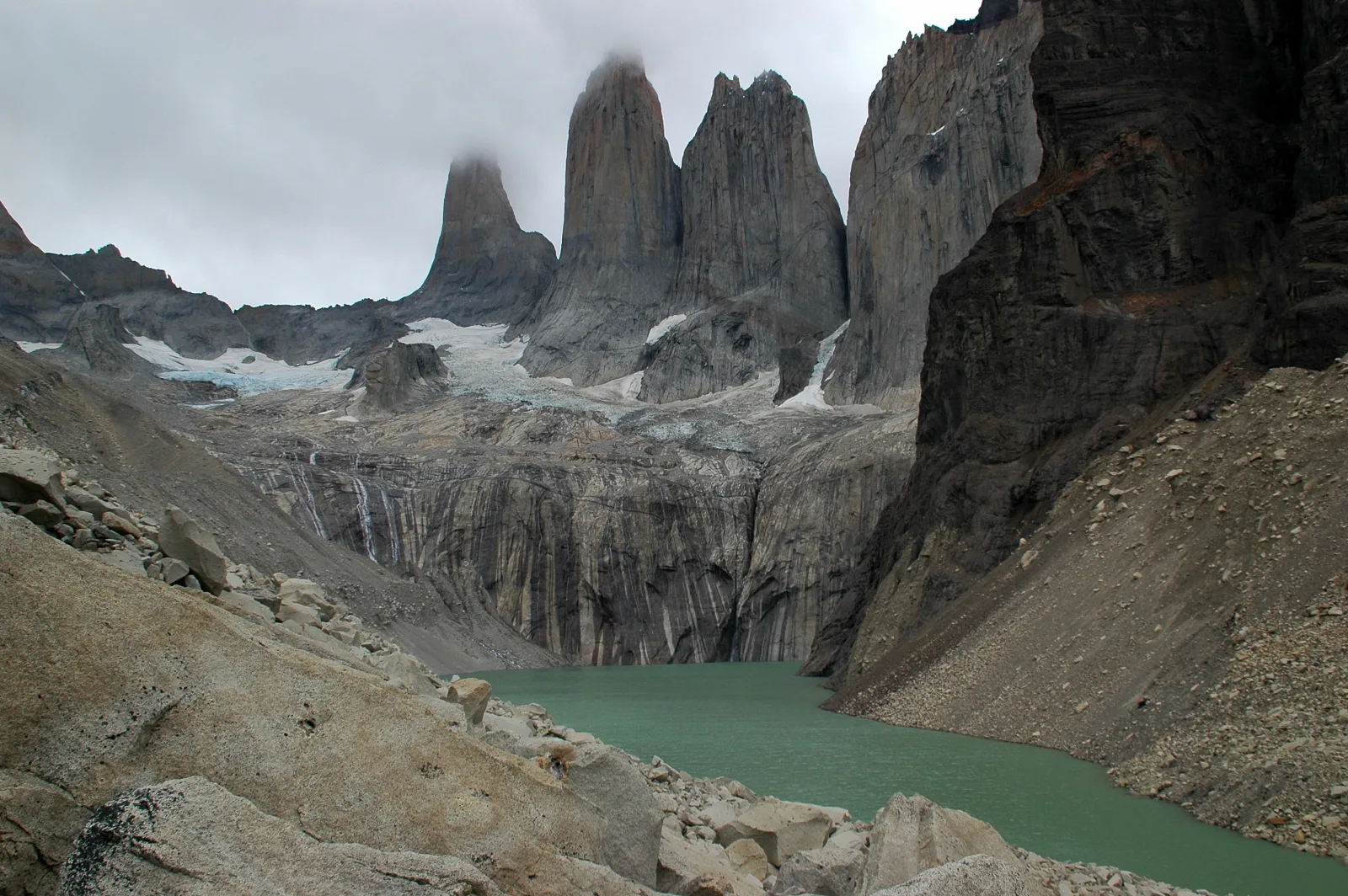
A country that measures 4,270 kilometres from north to south.
From the Peruvian border to Cape Horn, Chile is 4,270 kilometres long and on average only 200 kilometres wide. The Pacific lies on one side, the Andes on the other.
The Atacama lies in the north. Calama gets an average of 6.8 millimetres of rain a year. In the south, around Puerto Montt, it is over 1,500 millimetres. Further south still are the glaciers and granite peaks of Patagonia.
And 3,700 kilometres off the coast lies Rapa Nui, the island of the moai. It belongs to Chile, but you can only get there on a separate flight.
In short
Best time to go
November to March: summer in the southern hemisphere, the best time for Patagonia and the lakes. April, September and October are good in-between months. From May to August it is winter in the south, and Santiago gets most of its rain. The Atacama and Rapa Nui can be visited all year round.
How long
Two to three weeks. That lets you combine Santiago and Valparaíso with the Atacama and Patagonia, and possibly the lakes or Chiloé. Rapa Nui is added as a separate flight.
Who it suits
For travellers who love big landscapes and walking, and would rather fly the long distances than drive them. And for anyone who wants desert, glacier and island on one trip.
What sets it apart
On one trip you go from the Atacama, where Calama gets 6.8 millimetres of rain a year, to the ice of Patagonia. You fly between the regions; the distances are too great to do it all by road.
A tailor-made tour of Chile
A tour of Chile begins in Santiago. From there you fly north to Calama for the Atacama, and south to the lakes and Chiloé, to Balmaceda for the Carretera Austral, or to Punta Arenas and Puerto Natales for Torres del Paine. Valparaíso and the wine valleys are visited by road from Santiago. For Santiago with the Atacama and Patagonia, count on two to three weeks. If you want to see Rapa Nui, it is a flight of about five and a half hours from Santiago.
So the long distances are covered by domestic flights. Within a region you travel with your own driver or guide, or drive yourself. From Calama it is about an hour and a half by road to San Pedro de Atacama.
As a couple you decide how far you walk and how early you set off. With children Chile works well if you do not try to see too many regions: the distances between them are large. Travelling alone, a guide helps a great deal in the Atacama and Patagonia. With your own group of friends or family you travel in a private vehicle, and the group can split up: half on a multi-day trek in Torres del Paine, the other half on day walks.
The most unusual stays are in Torres del Paine. For the W and the full circuit around the Paine massif you must have a reserved place in the park's refugios or campsites; without one you cannot enter the mountain area. In the Atacama you stay in San Pedro, close to the salt flats. On Chiloé you sleep among the wooden churches of the islands. And on Rapa Nui your accommodation must be registered with the local authorities, otherwise you are not allowed onto the island.
From the desert in the north to the ice in the south.
Each region has its own season. The order of your trip depends on it.
Santiago
Every trip begins and ends in Santiago. In January it averages 30 degrees, in July 16. The domestic flights to the north and south leave from here.
Valparaíso and the wine valleys
Valparaíso was the main merchant port on the Pacific coast of South America until the Panama Canal opened in 1914. The city climbs the hillsides, with lifts from the early industrial era. In February and March the harvest begins in the wine valleys.
The Atacama
You fly from Santiago to Calama in about two hours and then drive to San Pedro de Atacama. Some of the places you visit here lie between 2,500 and 4,700 metres.
Puerto Montt and Chiloé
Around Puerto Montt more than 1,500 millimetres of rain fall each year, and you can see it in the green. On the islands of Chiloé, sixteen wooden churches are on the World Heritage List, out of a group of about seventy built by the Jesuit and Franciscan missions.
Patagonia and Torres del Paine
You fly from Santiago to Punta Arenas or Puerto Natales. In Torres del Paine park, glaciers and snow cover about 16 percent of the area, and some 130 bird species are recorded. Balmaceda is the way into the Carretera Austral.
Rapa Nui
Rapa Nui lies 3,700 kilometres off the Chilean coast, about five and a half hours by air from Santiago. The island has about 900 moai and more than 300 ceremonial platforms, the ahu.
You fly between the regions and take your time within them.
Chile is 4,270 kilometres long and on average 200 kilometres wide. Try to do it all by road and you spend most of your time in the car.
That is why a tour here works with domestic flights. From Santiago you reach the country's main cities in under 4 hours. Calama is about two hours' flying to the north. In the south there are direct flights to Balmaceda, Puerto Natales and Punta Arenas.
That leaves time within each region. In the Atacama for the salt flats and the night sky, in Patagonia for walking.
How you combine the regions depends on the season. We set them side by side and build the order that fits your travel dates.
Calama gets 6.8 millimetres of rain a year.Puerto Montt more than 1,500.
An island with its own rules for visitors.
Rapa Nui was settled by a society of Polynesian origin. From the tenth to the sixteenth century it built the ahu and raised the moai. The national park has been on the World Heritage List since 1995.
Visitors face their own set of rules. You may stay for at most 30 consecutive days. You need a return ticket, a passport valid for your whole stay and a booking at accommodation registered with the local authorities. Beforehand you fill in a separate entry form.
We arrange the flight from Santiago and registered accommodation, and place the island at the start or the end of your trip.
What could Chile be for you?
Directions to help you notice what draws you and what you would rather leave out.
The W in Torres del Paine
A multi-day trek with places reserved in advance in the park's refugios or campsites.
A day to Base Torres
For those who prefer day walks in Torres del Paine: no refugio reservation is needed for that.
Salt flats in the Atacama
From San Pedro de Atacama with a guide to the salt flats, and in the evening out under the night sky.
The churches of Chiloé
Wooden churches on the islands, built by the Jesuit mission.
Valparaíso on foot
Up the hills on the old lifts, and back down on foot.
The moai of Rapa Nui
The island with a guide, past the ahu and the moai that were never finished.
What you end up doing, we build around what drives you.
November to March, summer in the south.
November to March is summer. That is when Patagonia is easiest to reach: in Punta Arenas it averages 15 degrees in January, 4 in June and July. It is also the time for the lakes. In February and March the grape harvest begins.
September and October are spring. In the south, the walking season starts on the Carretera Austral. In April Santiago still averages 23 degrees.
May to August is winter. Santiago then gets most of its rain, an average of 80 millimetres in June. The Atacama, with 6.8 millimetres of rain a year in Calama, and Rapa Nui can be visited all year.
Best time to visit Chile
Who else is at their best in these months?
January February March November December
Use the contact form to discuss your travel dates and preferences with us.
What we look at differently.
Torres del Paine needs a reservation. For the W and the circuit around the massif you need a reserved place in a refugio or campsite. We arrange that first and build the rest of the trip around it.
Rapa Nui goes at one end. The island lies 3,700 kilometres off the coast. The flight from Santiago fits best at the start or the end of the trip.
The season has a say. Travel in July and the trip centres on the Atacama and Santiago. Travel in January and you can go all the way to Patagonia.
Practical, without the noise.
We go through the full, current picture with you personally, including what matters specifically for your trip.
Getting there
From Brussels you fly to Santiago with a connection. From there, you reach the regions on domestic flights.
Documents
Which travel documents you need depends on your nationality, and the rules change. The current travel advice states that Belgians need a passport valid for the whole stay, and no visa for stays under 90 days. Rapa Nui has extra rules. Check with the Belgian Foreign Affairs service. We confirm the current requirements before departure.
Health
Recommended vaccinations are listed on Wanda, the travel health site of the Institute of Tropical Medicine in Antwerp. Discuss it with your doctor too.
Travel advice
The current travel advice is published by the Belgian Foreign Affairs service. We follow it and adapt the trip where needed. Also register your trip on Travellers Online.
Driving yourself
According to the current travel advice you need a valid Belgian or international driving licence, and you must be able to show your passport at a check.
Earthquakes
Chile lies in a highly seismic area and has dozens of active volcanoes. In an emergency, follow the instructions of the local authorities.
Travelling with children
Very doable if you keep the number of regions down.
Frequently asked questions
When is the best time to go to Chile?
For Patagonia and the lakes, the best time in Chile is November to March. That is summer in the southern hemisphere. From May to August it is winter: Punta Arenas then averages 4 degrees and Santiago gets most of its rain. The Atacama and Rapa Nui can be visited all year.
For Patagonia and the lakes, the best time in Chile is November to March. That is summer in the southern hemisphere. From May to August it is winter: Punta Arenas then averages 4 degrees and Santiago gets most of its rain. The Atacama and Rapa Nui can be visited all year.
Do you need to book ahead for Torres del Paine?
Yes, for the W and the circuit around the massif in Torres del Paine, Chile, you reserve a place in the park's refugios or campsites in advance. Without that reservation you cannot enter the mountain area. This does not apply to day walks, such as to Base Torres.
Yes, for the W and the circuit around the massif in Torres del Paine, Chile, you reserve a place in the park's refugios or campsites in advance. Without that reservation you cannot enter the mountain area. This does not apply to day walks, such as to Base Torres.
What do you need for Rapa Nui?
For Rapa Nui, which belongs to Chile, you need a return ticket, a passport valid for your whole stay and a booking at accommodation registered with the local authorities. Beforehand you fill in a separate entry form. You may stay for at most 30 consecutive days.
For Rapa Nui, which belongs to Chile, you need a return ticket, a passport valid for your whole stay and a booking at accommodation registered with the local authorities. Beforehand you fill in a separate entry form. You may stay for at most 30 consecutive days.
What is the travel advice for Chile?
The current travel advice for Chile is on the website of the Belgian Foreign Affairs service, diplomatie.belgium.be, under Travel advice. We follow it before departure and during your trip, and adapt the trip if the advice changes.
The current travel advice for Chile is on the website of the Belgian Foreign Affairs service, diplomatie.belgium.be, under Travel advice. We follow it before departure and during your trip, and adapt the trip if the advice changes.
- Flight
- From Brussels you fly to Santiago with a connection
- Language
- Spanish
- Time difference
- 4 hours behind Belgium in the Belgian winter, 6 hours from April to early September, 5 hours in the weeks in between
- Length
- 4,270 kilometres from the Peruvian border to Cape Horn
- Domestic flights
- From Santiago to the country's main cities in under 4 hours