
One country on the map. Five journeys on the ground.
As the crow flies, New York is more than 3,900 kilometres from Los Angeles. That's further than Brussels to Baku. The contiguous states span four time zones. There are deserts where summer pushes past 49°C, and mountain roads that are usually not fully open until early July.
Try to see the United States in a single trip and what you mostly see is motorways and departure halls. We prefer to think in regions. The Southwest, with the canyons of Utah and Arizona. California. The Rockies around Yellowstone. New England in autumn. The Deep South. Each is a journey in its own right, and two that border each other make one together.
The thread running through it all is the national parks. Yellowstone became the world's first national park in 1872, and today 63 parks carry the title. They are well kept and well signposted, and in high season they can be full. The difference lies in when you come, where you sleep and how early you set off.
The country is too big to see everything. It's exactly big enough to choose.
In short
Best time to go
September and October are the only months when almost everything works at once: the mountain parks are still open and the desert is bearable. From April to August you choose by region, with the desert in spring and the mountains in summer. From November to March, it's mainly the South and the low desert.
How long
Two to three weeks for one or two neighbouring regions. If you want to see more, plan a second trip rather than a longer list.
Who it suits
Travellers who want to experience the landscape on foot, from a trail along a canyon rim to a walk up a river, and who enjoy long roads through empty country. Families too: most parks run a Junior Ranger programme for children.
What sets it apart
The country has protected its finest landscapes as national parks since 1872, and 63 parks carry that title today. They are spread across a country where New York lies more than 3,900 kilometres from Los Angeles as the crow flies.
Choose a region, not a country.
Each of these regions fills a trip. Two neighbours together works. Any more, and it's mostly driving.
The Southwest
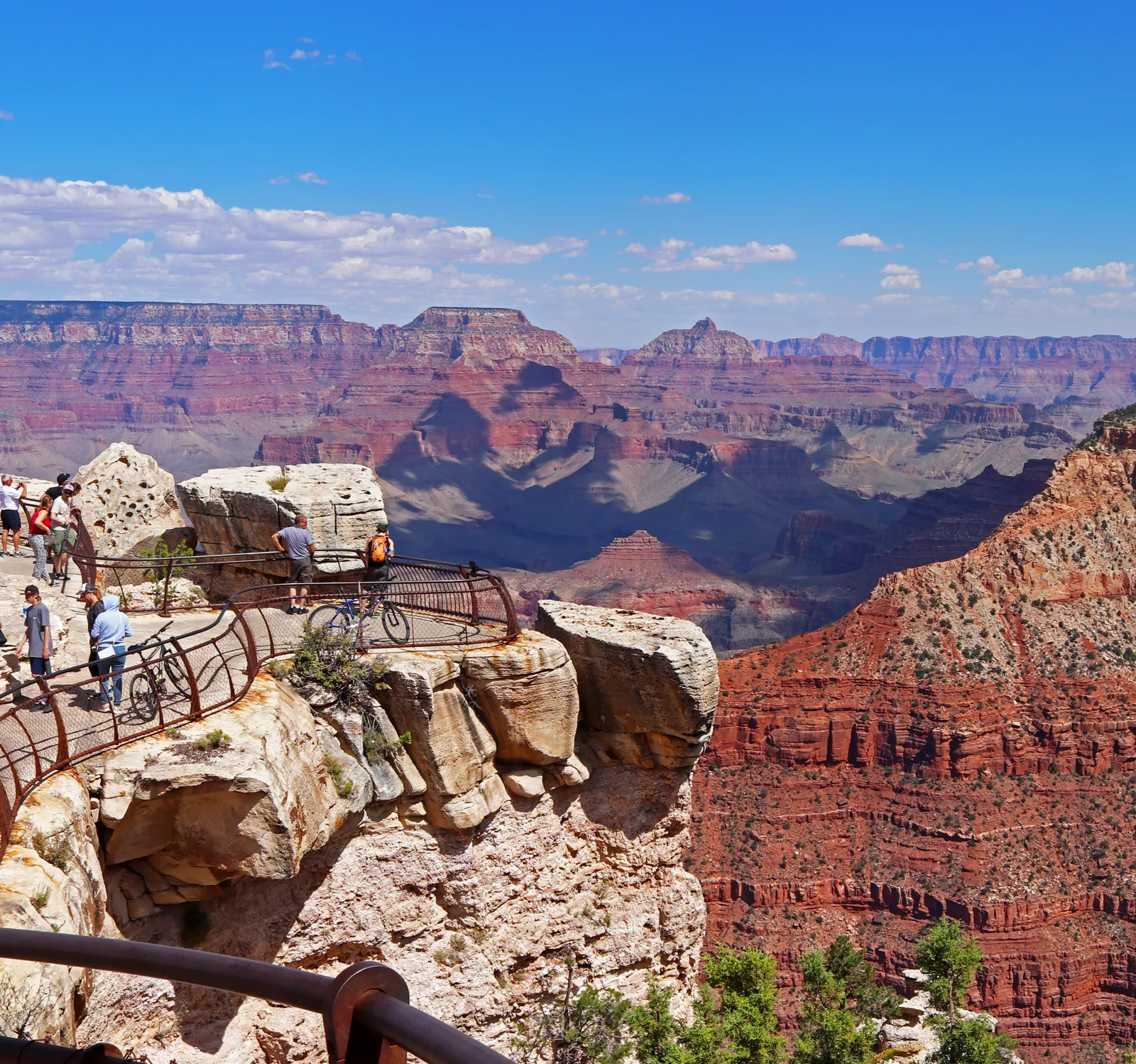
Red rock in every shape. Utah alone has five national parks: Zion, Bryce Canyon, Capitol Reef, Arches and Canyonlands. A little further south, in Arizona, lies the Grand Canyon, 1.6 kilometres deep. And on the border between the two states lies Monument Valley. It isn't a national park but a Navajo Nation park, and part of it can only be visited with a Navajo guide.
California
Here the extremes sit close together. Yosemite's waterfalls are at their strongest in May or June, and some are all but dry by August. Sequoia is the park of the giant trees. And in Death Valley, Badwater Basin lies 86 metres below sea level, the lowest point in North America.
The Rockies and Yellowstone
Yellowstone is the oldest national park, and a parkway links it directly to Grand Teton. Bison and elk graze in the Lamar Valley, which the park service calls one of the best places in the world to watch wolves. Further north, in Montana, Glacier's Going-to-the-Sun Road crosses the mountains.
New England
Rocky headlands, fishing harbours and forests that turn in autumn: in northern Maine around the end of September, on the coast from mid to late October. Acadia is Maine's only national park. From 7 October to 6 March, the summit of Cadillac Mountain, 466 metres high, is the first place in the country to see the sunrise.
The Deep South
Here the thread is history and music more than landscape. Great Smoky Mountains, on the border of Tennessee and North Carolina, is the most visited national park in the country, with 11.5 million visits in 2025. In Alabama, an 87-kilometre historic trail follows the 1965 voting rights march from Selma to Montgomery. And in the French Quarter of New Orleans, the park service runs a park devoted to the roots of jazz.
Two regions with time in them.Not five seen from the interstate.
A tailor-made tour of the United States
A tour of the United States starts with a choice. The Southwest and California border each other and sit well together: first the canyons of Utah and Arizona, then the Sierra Nevada or the coast. The Rockies around Yellowstone and Grand Teton make a journey of their own, and if you like, you continue north to Glacier. New England and the Deep South each stand alone. For one or two regions, allow two to three weeks.
You mostly travel by road here, because the parks lie far from each other and far from the big cities. That can mean a rental car, or a private driver if you'd rather look than drive. Between regions that don't border each other, you take a domestic flight. And then there's the train: the California Zephyr runs from Chicago to San Francisco in just over 51 hours, through the Rockies and the Sierra Nevada. That isn't transport. It's part of the journey.
As a couple, you choose the hours when the parks are quiet: out early, a rest in the afternoon, an evening somewhere you no longer need to drive. With children, the country works remarkably well. Most parks run a Junior Ranger programme, in which children complete activities along the way and earn a badge. Travelling alone is easy, though the driving asks more of you. And with your own group of friends or family, you choose places to stay with room for everyone, and a driver who takes the long stretches.
The memorable places to stay are inside the parks or close to them. Luxury in the United States means something different from elsewhere: not the biggest hotel, but a room within walking distance of the trailhead, so you're out before the day visitors arrive. Those places are in demand, so we start on them early. The pace follows the light and the heat. Travel like that, and you see more while driving less.
The thread through every journey.
Yellowstone became a national park on 1 March 1872, the first in the world. Today the National Park Service manages 433 sites, from battlefields to coastlines, and 63 of them carry the title of national park.
For your trip, that means good roads, clear information and rangers who explain what you're looking at. In high season it also means rules: timed slots to drive in, and for a few hikes, such as Angels Landing in Zion, a permit awarded by lottery.
A park here isn't a day out. It's a place to stay.
Stone
Arches has more than 2,000 natural stone arches. Bryce Canyon has the largest concentration of hoodoos on earth. Both are at their best in the low light of early morning and late afternoon.
Water and fire
Yellowstone has more than 10,000 hydrothermal features: geysers, hot springs, mud pots. With more than 500 active geysers, the park holds more than half of all the geysers on earth.
Granite and giants
In Yosemite, El Capitan rises more than 900 metres above the valley floor. In Sequoia stands General Sherman, 83.8 metres tall and the largest tree in the world by volume.
Logan Pass in Glacier, at 2,026 metres. The road up is usually not fully open until early July.
What could the United States be, for you?
Not fixed stops on a set route, but directions, to help you notice what draws you in and what you'd rather leave out.
A walk up the river
In Zion's Narrows, you walk up the river itself, between rock walls 300 metres high. It only works when the river allows: at high water the canyon closes, and a flash flood is always possible. So we decide on the day.
Watching wolves in the Lamar Valley
Out early with a guide and a spotting scope, in the valley where bison and elk graze. You watch from a distance: at least 91 metres from wolves and bears is the rule.
Monument Valley with a Navajo guide
The best-known rocks in the West stand on Navajo Nation land. Part of the valley can only be visited with a guide from there, and that's exactly why you'd want to do it this way.
Through the Rockies by train
The California Zephyr runs from Chicago to San Francisco in just over 51 hours, over the Rockies and through the Sierra Nevada. You don't have to ride the whole line: one stretch of it links two regions, no plane needed.
From Selma to Montgomery
87 kilometres along the route of the 1965 voting rights march. With someone who knows the story from the inside, it becomes more than a series of memorials.
First light on Cadillac Mountain
From 7 October to 6 March, this is where the country sees the sun rise first. Driving to the summit requires a reservation from mid-May to mid-October.
These are possibilities.Not your journey.
No single season, but two months that open almost everything.
September and October are the only months when almost everything works at once. In Arches, autumn days from mid-September to the end of October sit between 16 and 27°C. Yellowstone's roads stay open until the end of October, the highest pass until mid-October. And in New England the forests turn: in northern Maine around the end of September, on the coast from mid to late October.
From April to August you choose by region. In April and May the Southwest desert is at its most pleasant, and in May or June Yosemite's waterfalls are at their strongest. Meanwhile the mountains open step by step: Yellowstone's first roads in mid-April, the highest only in late May. July and August belong to the Rockies. By then Arches often climbs above 37°C and Death Valley above 49°C.
From November to March most of Yellowstone's roads are closed, and even the high desert is cold: in January, Arches averages 7°C by day and freezes at night. What remains is the South and the low desert. In Death Valley, winter and spring are precisely the pleasant seasons.
On the southern coast, keep an eye on hurricane season. It runs from 1 June to 30 November, with most activity between mid-August and mid-October. For Florida and the Deep South coast, we talk it through beforehand.
Best time to visit United States
Who else is at their best in these months?
September October
Use the contact form to discuss your travel dates and preferences with us.
A geyser steaming in the morning cold. A stone arch glowing in the last of the light.
Where we look at it differently.
Two regions, not five. It's tempting to fit the East Coast, the canyons and California into one trip. Then you spend more time in the car and in airports than in the parks. Two neighbouring regions give a journey with room in it.
The Grand Canyon has two sides. On average the canyon is 16 kilometres wide, yet from the South Rim to the North Rim is a 346-kilometre drive, about five hours. The South Rim is open all year, the North Rim only in the summer season, in 2026 from 15 May to 15 October. Which side you choose shapes the rest of the route.
The rules change every year. In 2026, Rocky Mountain uses timed entry from late May to mid-October. Arches, Glacier and Yosemite require no reservation to drive in during 2026, although Arches still used one in 2025. Plan on last year's rules and you plan wrong. We check them for your travel dates.
Heat is not a detail. In summer, Death Valley often climbs above 49°C, and Arches regularly above 37°C. We plan the desert for spring or autumn, or put the hikes in the early morning.
Practical, without the noise.
We go through the full, up-to-date picture in person, including whatever matters specifically for your trip.
Getting there
In the 2026 summer season there were direct flights from Brussels to New York, Newark, Washington, Chicago and Atlanta: about 8.5 hours to New York, 10 hours to Atlanta. The schedule varies by season. The West Coast is one stopover away.
Documents
Belgians are generally eligible for a visa waiver and then travel with an ESTA, an electronic travel authorisation you apply for online in advance. An ESTA or a visa does not guarantee entry, and the conditions change. Check the current rules for your situation; we confirm them with you before you leave.
Health
Recommended vaccinations are listed on Wanda, the travel health site of the Institute of Tropical Medicine in Antwerp. Discuss it with your doctor too.
Travel advice
The current travel advice is published by the Belgian Foreign Affairs service. We follow it and adapt the trip where needed. Also register your trip on Travellers Online.
Time difference
The East Coast is 6 hours behind Belgium, the West Coast 9. Because the US changes its clocks earlier in March and later in autumn, the difference is one hour smaller for a few weeks a year. Arizona does not observe daylight saving time, except on Navajo Nation land.
Driving yourself
If you plan to drive, the travel advice says to bring an international driving permit. Distances are large, so we plan the driving days with you.
Park reservations
Timed entry, permits by lottery and reservations for certain roads vary by park and by year. We check them for your travel dates.
Frequently asked questions
When is the best time to visit the United States?
In September and October, almost everything in the United States works at once: the mountain parks are still open and the desert is bearable. From April to August you choose by region, with the Southwest desert in spring and the Rockies and Yellowstone in summer. From November to March, most of Yellowstone's roads are closed and it's mainly the South and the low desert.
In September and October, almost everything in the United States works at once: the mountain parks are still open and the desert is bearable. From April to August you choose by region, with the Southwest desert in spring and the Rockies and Yellowstone in summer. From November to March, most of Yellowstone's roads are closed and it's mainly the South and the low desert.
Which national parks can you combine in one trip?
In the United States, it's best to combine parks within the same region. Zion, Bryce Canyon, Capitol Reef, Arches and Canyonlands are all five in Utah, and the Grand Canyon lies in neighbouring Arizona. Yellowstone and Grand Teton are linked by a parkway. Yosemite, Sequoia and Death Valley are in California, although in summer Death Valley often climbs above 49°C.
In the United States, it's best to combine parks within the same region. Zion, Bryce Canyon, Capitol Reef, Arches and Canyonlands are all five in Utah, and the Grand Canyon lies in neighbouring Arizona. Yellowstone and Grand Teton are linked by a parkway. Yosemite, Sequoia and Death Valley are in California, although in summer Death Valley often climbs above 49°C.
Can you travel the United States with children?
Yes, the United States works well with children. Most parks run a Junior Ranger programme, in which children complete activities along the way and earn a badge. What matters most is distance: we keep the driving days short and choose one or two regions, so there's time left to hike, swim and play.
Yes, the United States works well with children. Most parks run a Junior Ranger programme, in which children complete activities along the way and earn a badge. What matters most is distance: we keep the driving days short and choose one or two regions, so there's time left to hike, swim and play.
What is the travel advice for the United States?
The current travel advice for the United States is on the website of the Belgian Foreign Affairs service, diplomatie.belgium.be, under Travel advice. We follow it before departure and during your trip, and adapt the trip if the advice changes.
The current travel advice for the United States is on the website of the Belgian Foreign Affairs service, diplomatie.belgium.be, under Travel advice. We follow it before departure and during your trip, and adapt the trip if the advice changes.
- Flight time
- About 8.5 hours direct to New York, 10 hours to Atlanta; one stopover to the West Coast
- Language
- English; Spanish is the language most spoken at home after English
- Time difference
- -6 hours on the East Coast to -9 hours on the West Coast; one hour less for a few weeks a year
- Time zones
- Four in the contiguous states; Arizona does not observe daylight saving time
- National parks
- 63, with Yellowstone, from 1872, the first
- Strongest periods
- September and October; from April to August depending on the region