
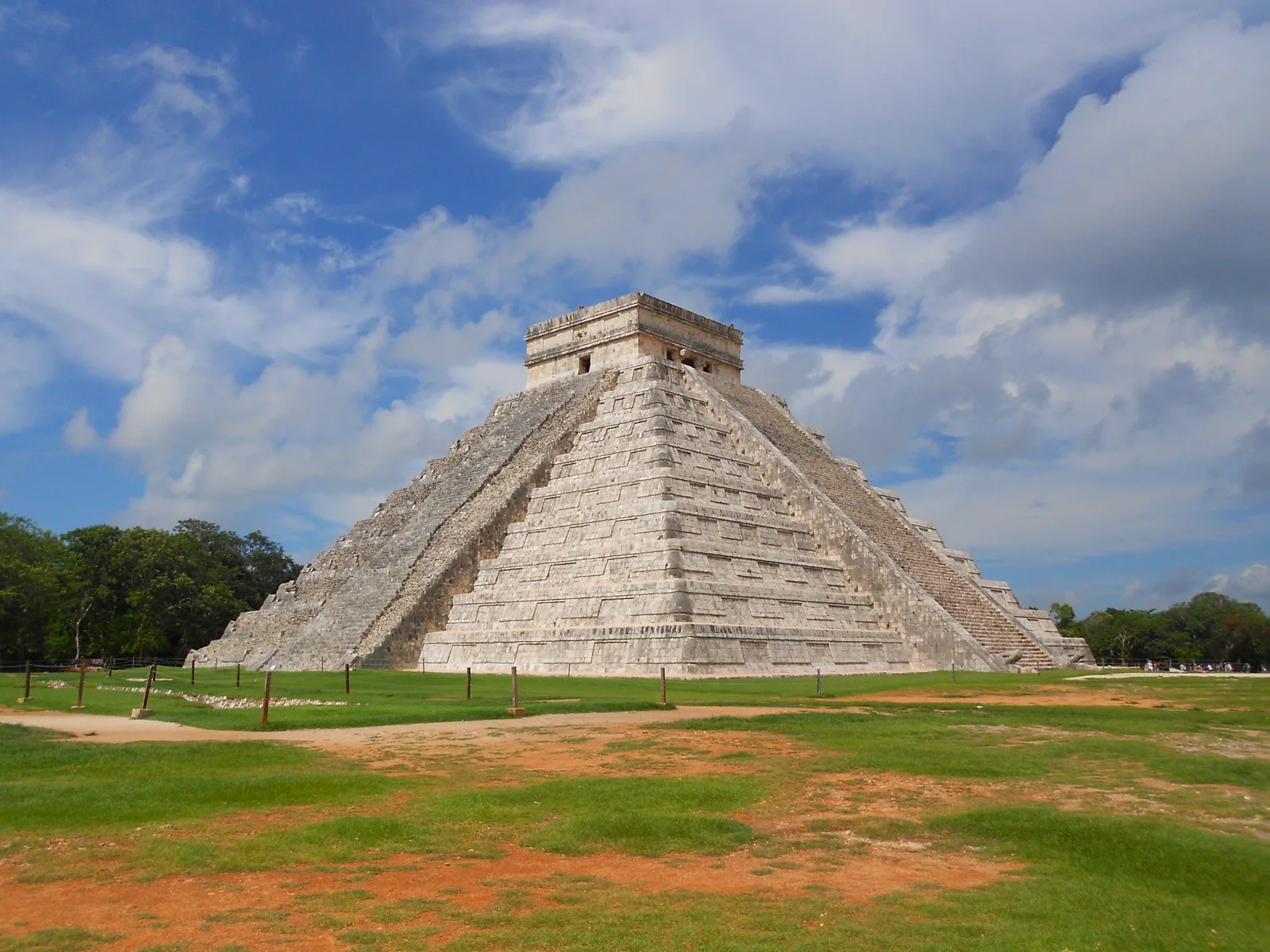
A capital on top of an Aztec city, and Maya cities in the forest.
The Aztecs built their capital, Tenochtitlan, on a small island in Lake Texcoco. In the sixteenth century the Spaniards built Mexico City on its ruins.
In the south-east lies the Yucatán peninsula. Here you find the Maya cities of Uxmal and Chichén Itzá, the fortified town of Campeche and, deep in the tropical forest, the Maya city of Calakmul.
A tour with us stays in the capital, Puebla and the Yucatán peninsula.
In short
Best time to go
December to March: dry in the highlands and in Yucatán, with days of 29 to 33 degrees in Mérida. April and November are good in-between months. Most rain falls from May to October, and the hurricane season on the Atlantic coast runs from June to the end of November.
How long
Fourteen to eighteen days. That lets you combine Mexico City and Puebla with Yucatán: Mérida, Uxmal, Chichén Itzá, Campeche and Calakmul. With less time, you choose either the capital or Yucatán.
Who it suits
For travellers who want to see ancient cities where they were built, and would like to spend a few days in the tropical forest. For anyone who finds a colonial town as absorbing as a pyramid.
What sets it apart
On one trip you see an Aztec capital beneath a colonial city and Maya cities in the forest. You fly between the capital and Yucatán.
A tailor-made tour of Mexico
A tour of Mexico usually starts in Mexico City. From there you go to Puebla, about 100 kilometres to the east. Then you fly to Yucatán and travel via Mérida, Uxmal, Chichén Itzá and Campeche to the Calakmul forest. Sian Ka'an lies on the east coast of the peninsula. For that combination, count on fourteen to eighteen days.
Within each region you travel with your own driver. Between the capital and Yucatán you take a domestic flight.
As a couple you have a guide and driver to yourselves, and you reach the sites early, before the heat. With children Mexico works well if the days are not too full: a boat on the canals of Xochimilco and a day in the Calakmul forest both appeal to children. Travelling alone, a regular guide and driver help a great deal, certainly in the capital. With your own group of friends or family you travel in a private vehicle, and the group can split for a day: half to a Maya site, the other half in Mérida.
The most unusual stays are around Calakmul, deep in the tropical forest. In Mexico City you stay in the centre around the Zócalo or in a district such as Roma, Condesa, Polanco or Coyoacán. In Puebla and Campeche you sleep in the old town, among the colonial facades.
The capital, Puebla and the Yucatán peninsula.
Mexico is far larger than these regions. A tour with us stays here.
Mexico City and Xochimilco
The Spaniards built the city in the sixteenth century on the ruins of Tenochtitlan. The centre holds the remains of five Aztec temples and a cathedral. Xochimilco lies 28 kilometres to the south, with canals and artificial islands from Aztec times.
Puebla
Puebla was founded in 1531, about 100 kilometres east of Mexico City, at the foot of Popocatépetl. The city has a sixteenth and seventeenth-century cathedral and many houses with tiled facades.
Mérida and Uxmal
Uxmal lies 62 kilometres south of Mérida. The Maya city was founded around 700 and had some 25,000 inhabitants. It is the centre of the Puuc, a region of low hills with its own architectural style.
Chichén Itzá
Chichén Itzá grew up beside two natural wells, the cenotes, which gave access to groundwater. It was one of the largest Maya centres on the peninsula, with El Castillo, the Temple of the Warriors and the round observatory known as El Caracol.
Campeche and Calakmul
Campeche is a colonial port that has kept its walls and fortifications against attacks from the sea. Inland, deep in the tropical forest, lies the Maya city of Calakmul, in a protected area of 331,397 hectares.
Sian Ka'an
On the east coast of Yucatán, in Quintana Roo, Sian Ka'an protects 528,148 hectares of tropical forest, mangroves, marshes and sea with a barrier reef. More than 300 bird species are found here.
The Aztecs, the Maya and the Spaniards.
On one trip you see three eras, each of which built its own cities. All three are on the World Heritage List.
Mexico City and Xochimilco
The capital stands on the ruins of Tenochtitlan, and Xochimilco keeps canals and artificial islands from Aztec times. World Heritage since 1987.
Uxmal and Chichén Itzá
Two Maya cities in Yucatán. Uxmal was founded around 700; Chichén Itzá had a history of almost a thousand years. World Heritage since 1996 and 1988.
Puebla and Campeche
Puebla was founded in 1531. Campeche kept its city walls. World Heritage since 1987 and 1999.
Calakmul lies deeper in the forest than the other Maya cities.
Calakmul lies in the central and southern part of the peninsula, in the tropical forest of the Tierras Bajas. The city played a key role in the region for more than twelve centuries.
The protected area around it covers 331,397 hectares. Together with its buffer zone it makes up the entire Calakmul Biosphere Reserve.
On the east coast lies Sian Ka'an, a different kind of nature: forest, mangroves and marshes that merge into the sea.
We plan one or two nights near Calakmul, so that you visit the site early in the day.
What could Mexico be for you?
Directions to help you notice what draws you and what you would rather leave out.
The canals of Xochimilco
By boat between the artificial islands, 28 kilometres south of the centre.
Puebla and its tiles
The cathedral and the tile-fronted houses of the old town.
The Puuc around Uxmal
Uxmal and the smaller sites in the hills south of Mérida.
Calakmul in the forest
A Maya city deep in the tropical forest, early in the day.
By boat in Sian Ka'an
Through the mangroves of the biosphere reserve on the east coast.
What you end up doing, we build around what drives you.
December to March, the dry season.
December to March is the dry period. Mexico City then gets at most 10 millimetres of rain a month, with days of 21 to 25 degrees. In Mérida daytime temperatures reach 29 to 33 degrees.
April and November are good in-between months. By April Mérida is already around 35 degrees; in November there is much less rain than in the months before.
Most rain falls from May to October: in Mexico City an average of 133 millimetres in July, in Mérida 180 in September. On the Atlantic coast the hurricane season runs from early June to the end of November.
Best time to visit Mexico
Who else is at their best in these months?
January February March December
Use the contact form to discuss your travel dates and preferences with us.
What we look at differently.
One flight between two regions. Between Mexico City and Yucatán you take a domestic flight, so there are no long drives between the two regions.
One or two nights near Calakmul. Calakmul lies deep in the forest. With one or two nights nearby, you visit the site early in the day.
Early at the sites. In Mérida the average in May is 36 degrees. We plan the Maya sites early in the day.
Practical, without the noise.
We go through the full, current picture with you personally, including what matters specifically for your trip.
Getting there
From Brussels you fly to Mexico City with a connection. We look with you at which connection suits you best.
Documents
Which travel documents you need depends on your nationality, and the rules change. Check with the Belgian Foreign Affairs service. According to the travel advice, children under 18 travelling without their parents need parental consent. We confirm the current requirements before departure.
Health
Recommended vaccinations are listed on Wanda, the travel health site of the Institute of Tropical Medicine in Antwerp. Discuss it with your doctor too.
Travel advice
The current travel advice is published by the Belgian Foreign Affairs service. We follow it and adapt the trip where needed. Also register your trip on Travellers Online.
Driving yourself
According to the current travel advice, a Belgian category B licence is accepted for stays of under 3 months. We work with a private driver.
Local laws
E-cigarettes are banned in Mexico.
Frequently asked questions
When is the best time to go to Mexico?
The best time for a tour of Mexico is December to March. It is dry then in the highlands and in Yucatán, with days of 29 to 33 degrees in Mérida. Most rain falls from May to October, and the hurricane season on the Atlantic coast runs from June to the end of November.
The best time for a tour of Mexico is December to March. It is dry then in the highlands and in Yucatán, with days of 29 to 33 degrees in Mérida. Most rain falls from May to October, and the hurricane season on the Atlantic coast runs from June to the end of November.
Which regions of Mexico does a tour cover?
A tour of Mexico with us stays in Mexico City, Puebla and the Yucatán peninsula, with Mérida, Uxmal, Chichén Itzá, Campeche, Calakmul and Sian Ka'an.
A tour of Mexico with us stays in Mexico City, Puebla and the Yucatán peninsula, with Mérida, Uxmal, Chichén Itzá, Campeche, Calakmul and Sian Ka'an.
How do you travel between Mexico City and Yucatán?
Between Mexico City and Yucatán you take a domestic flight. Within each region you travel with your own driver.
Between Mexico City and Yucatán you take a domestic flight. Within each region you travel with your own driver.
What is the travel advice for Mexico?
The current travel advice for Mexico is on the website of the Belgian Foreign Affairs service, diplomatie.belgium.be, under Travel advice. We follow it before departure and during your trip, and adapt the trip if the advice changes.
The current travel advice for Mexico is on the website of the Belgian Foreign Affairs service, diplomatie.belgium.be, under Travel advice. We follow it before departure and during your trip, and adapt the trip if the advice changes.
- Flight
- From Brussels you fly to Mexico City with a connection
- Language
- Spanish; in addition, 68 indigenous peoples speak 364 language variants between them
- Time difference
- Mexico City is 7 hours behind Belgium in the Belgian winter, 8 hours in the Belgian summer; Cancún 6 and 7 hours
- World Heritage on the route
- Mexico City, Puebla, Uxmal, Chichén Itzá, Campeche and Calakmul
- Best period
- December to March